
An aluminium door canopy can be a fairly simple bit of rain cover – or it can become one of the main architectural features at the front of the house.
That’s why choosing one purely from a photograph is risky.
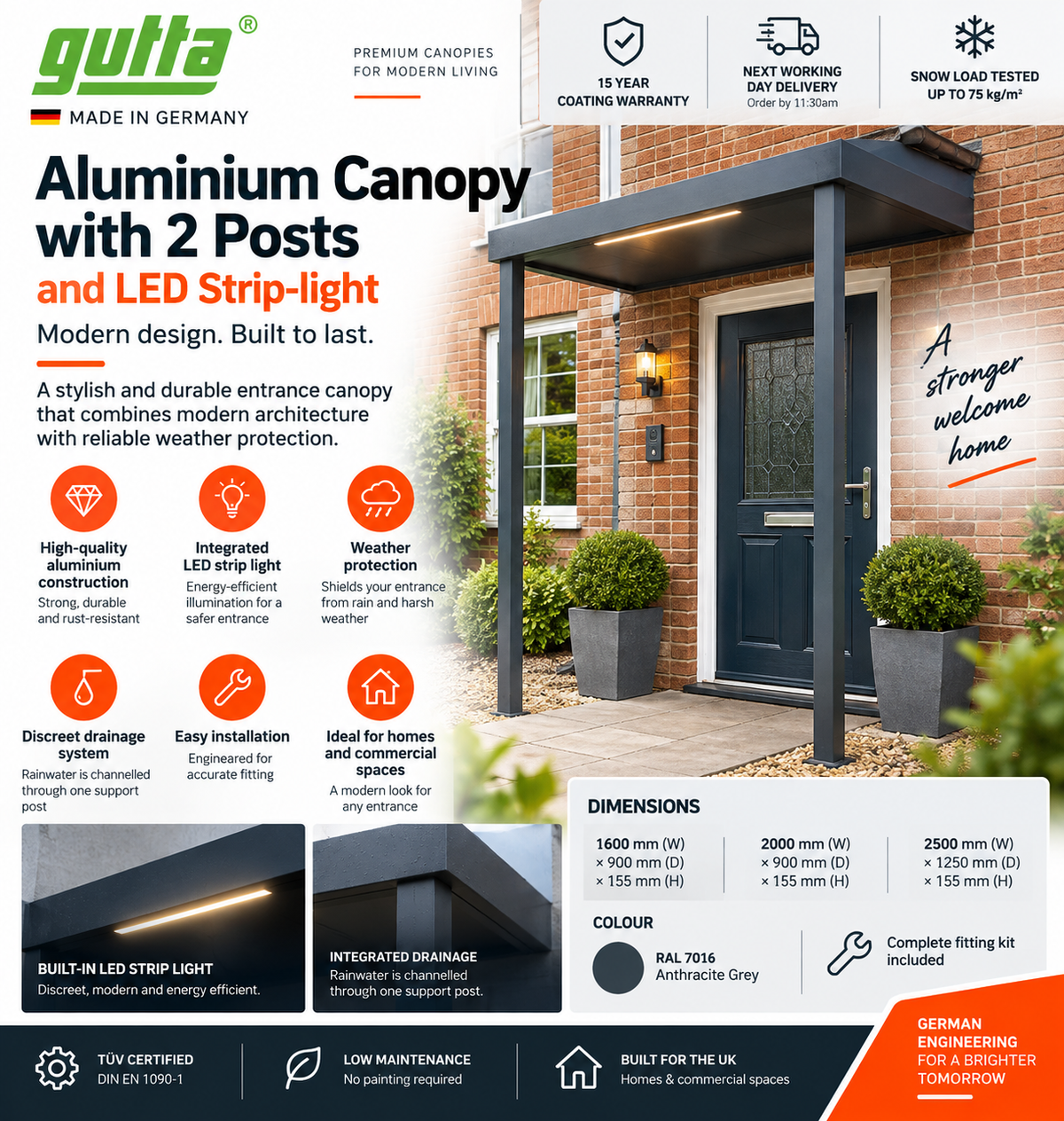
Our aluminium canopies range includes compact roof-only designs, wider entrance canopies, models with side panels, integrated LED lighting, support posts, hidden drainage and bespoke colour options. They may all be made predominantly from aluminium, but they don’t all do the same job.
Before ordering, these are the seven things we’d check.
1. Measure the whole entrance, not just the door
This catches people out surprisingly often.
If your door leaf is 900mm wide, that doesn’t necessarily mean a 1000mm canopy is the right size. You may also have:
- A wide door frame
- Side lights
- Brick or rendered reveals
- External lights
- A video doorbell
- Downpipes
- Windows close to the entrance
Measure the complete area you actually want covered.
A 1600mm canopy can look nicely proportioned over a standard front entrance, while 2000mm and 2500mm models make more sense once you have wider doors, glazing or simply want more shelter either side.
Then measure projection.
This is how far the canopy comes out from the wall. A canopy can look huge when viewed from the front but still offer relatively little shelter if it has a shallow projection.
If keeping yourself dry while unlocking the door is important, projection matters just as much as width.

The 250x90cm Top Door Canopy. In Stock Now.
2. Decide how much weather protection you actually need
Not every entrance needs a side panel and two support posts.
If your front door is already relatively sheltered, a simple roof-only aluminium canopy can be enough. It keeps the design clean and gives you cover without making the doorway feel enclosed.
Things change if the entrance regularly gets hit by wind-driven rain.
In that situation, one of our door canopies with sides can make much more sense. The side panel helps protect the doorway from weather coming across the elevation rather than straight down.
Before choosing left or right, have a look at the entrance during poor weather.
It sounds painfully obvious, but it’s more useful than guessing from a product photograph.
3. Look at where the rainwater actually goes
Drainage isn’t the glamorous part of choosing a canopy.
It is, however, one of the things you’ll notice very quickly if you get it wrong.
Depending on the design, an aluminium canopy might:
- Shed water from a defined edge
- Use a small water outlet or spout
- Incorporate its own gutter
- Direct water through a side panel
- Hide drainage within a support post
Think about what is directly underneath.
If the canopy discharges water onto your front step, footpath or exactly where visitors stand, you’ve simply moved the rain problem by a metre.
Some of our Alumasc door canopies are particularly useful where controlled drainage matters. The Skyline CA160, for example, incorporates a gutter within the canopy and can connect into a rainwater system rather than simply allowing water to run from the front edge.
If you’re specifying the rest of the rainwater system at the same time, our aluminium guttering can also be colour coordinated with other external aluminium elements.

The Heritage Aluminium Ogee Rainwater System in use.
4. Work out whether integrated lighting is worth having
There are plenty of front doors where a separate wall light does the job perfectly well.
But integrated lighting can look much cleaner.
Several of our aluminium canopy designs incorporate either LED strips or spotlights into the underside of the canopy. That gives you useful entrance lighting without adding another fitting above or beside the door.
It works particularly well with dark aluminium.
Anthracite and black canopies can look fairly understated during the day, then completely different once the underside is illuminated at night.
If you are already replacing the front door, external lighting or entrance glazing, it is worth making this decision before everything else has been installed.
Retrofitting cables afterwards is rarely the neatest option.
5. Don't assume every 'aluminium canopy' is the same thing
This is an important one.
Search for an aluminium door canopy online and you’ll find products ranging from inexpensive aluminium-framed polycarbonate shelters to much more substantial architectural aluminium systems.
Both have their place.
A lightweight aluminium frame with a clear roof can be ideal if you simply need affordable cover above a back or side door.
At the other end of the scale, architectural canopies can incorporate formed aluminium roof sections, insulation, drainage, posts, side panels, lighting and bespoke finishes.
That difference explains why one product might cost a few hundred pounds and another several thousand.
If budget is the main priority, have a look at our polycarbonate front door canopies as well.
If the canopy is going above the main entrance and forms a prominent part of the house, it may be worth spending more on the finish and construction.

6. Match the canopy to the building – not just the front door
Anthracite grey has become the default choice for a lot of modern homes.
And, to be fair, it works.
RAL 7016 tends to sit nicely alongside anthracite windows, composite doors, bifolds and contemporary roofline products.
But it isn’t the only answer.
Black can look sharper against pale render or brick, while selected aluminium canopy systems can be ordered in bespoke RAL colours to match windows, cladding or other metalwork.
The shape matters too.
A flat rectangular canopy gives you a very different result from a hipped roof, while our Brise Soleil aluminium canopies use projecting blades to create something far more architectural.
There are also Timber-Line designs that introduce real timber detailing into the aluminium structure. They can work brilliantly where an all-metal canopy feels a bit too stark.
Don't automatically pick whichever model looks best in isolation.
Look at the windows, roofline, front door and materials already on the property.

The Timberline Canopy With Drainage.
7. Decide whether a standard size will actually work
Standard sizes make life easier.
They're usually quicker to supply, easier to price and, for most normal domestic entrances, perfectly suitable.
But there are plenty of buildings where standard just doesn't look right.
You may have:
- An unusually wide entrance
- Double doors
- Large side lights
- A commercial doorway
- An architect-specified width
- A particular projection requirement
- A RAL colour already specified elsewhere on the building
Selected aluminium canopy systems can be manufactured to suit these projects.
The important thing is to get the specification right before manufacture begins. Bespoke and made-to-order products are normally much harder – or impossible – to return simply because the wrong dimension or colour was ordered.
Measure twice really does apply here.
One more thing: check what you're fixing into
The canopy can be perfect and the installation can still go wrong if the wall hasn't been considered.
Brick, blockwork, concrete, timber-frame construction, external insulation and cladding systems can all require different fixing approaches.
Larger aluminium canopies can also be surprisingly substantial once assembled.
Before ordering, check where the supporting brackets or structure will sit and make sure you aren't about to clash with windows, lintels, services or unsuitable areas of the façade.
If you're unsure whether you're allowed to fit one in the first place, we've also put together a guide answering Can I Put a Canopy Over My Front Door?.
So, which aluminium canopy is right for you?
For a straightforward entrance, don't overcomplicate it. A clean roof-only canopy in the right width and projection may be all you need.
For an exposed doorway, look at a side panel.
For a wider or more architectural entrance, consider posts and integrated drainage.
And if the front of the house has already had money spent on new windows, doors and lighting, an LED or bespoke-colour canopy can finish it off properly.
You can browse the full range of aluminium door canopies, or explore our wider front door canopy collection if you're still deciding between aluminium, glass, polycarbonate, zinc and other materials.
