
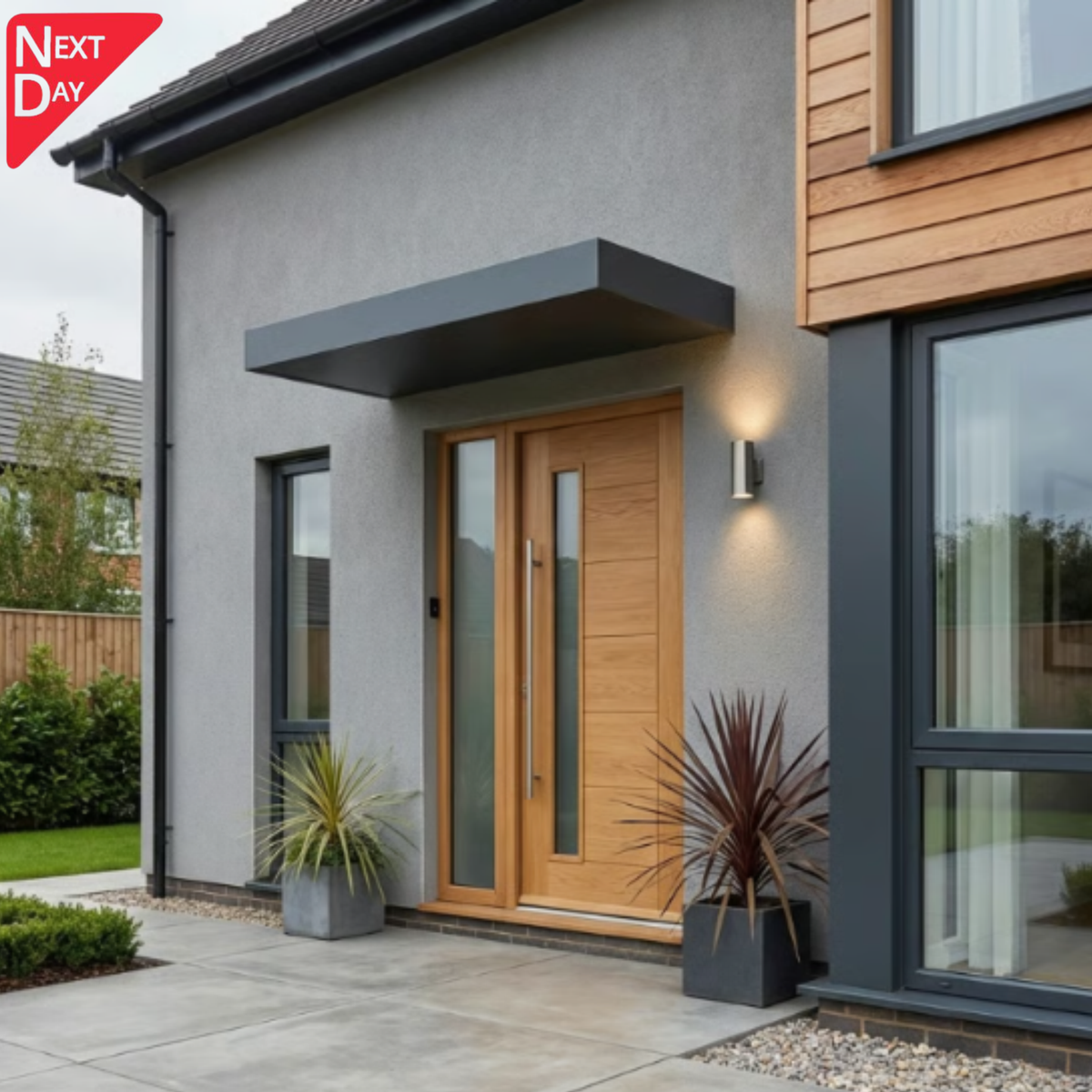
There can be more than £2,000 between two premium aluminium canopy configurations, even when both are designed to cover an ordinary entrance. That sounds extreme until you compare what you are actually getting.
A simple Alumasc Skyline canopy can provide clean aluminium shelter above the door with very little visual fuss. Move across to a higher-spec Gutta system and you can have integrated LED lighting, a full-height side panel, support posts and rainwater routed discreetly through the structure itself.
They are both aluminium door canopies. They are not necessarily competing for exactly the same job.
Gutta and Alumasc are two of the strongest names you'll encounter when looking for a higher-quality aluminium entrance canopy in the UK. Both offer contemporary designs, powder-coated finishes and options beyond the basic plastic canopy you might find at a DIY retailer. However, the character of the two ranges is noticeably different.
Gutta tends to make the stronger case when you want the canopy to become a complete entrance feature. Alumasc Skyline tends to make more sense when you want a clean architectural canopy, broad colour choice or a product that can be specified closely around the building.
Neither manufacturer wins every category.
Here's how to work out which one is right for your entrance.

A Side by Side Comparison
Gutta or Alumasc? The 60-Second Answer Before We Get Technical
If we had to reduce the comparison to one difference, it would be this: Gutta generally gives you more integrated features, while Alumasc generally gives you more architectural specification choice.
Gutta's rectangular BS range is heavily influenced by Bauhaus design.
Think straight lines, a substantial rectangular roof, Anthracite Grey aluminium and options that turn the canopy into much more than a panel above your door.
Depending on the model, you can add integrated LED lighting, side screens, support posts and concealed rainwater drainage. There are also more distinctive designs such as Timber-Line and 3D-Line for homeowners who don't want a completely plain aluminium box.
Alumasc Skyline takes a slightly different approach. Its simpler canopy ranges tend to have a cleaner and more restrained appearance, with different front-edge depths and drainage arrangements depending on the model. Where Alumasc becomes particularly interesting is colour and specification. The manufacturer currently offers a wide standard RAL palette, with further BS and RAL colours available to order, making it easier to coordinate a canopy with aluminium windows, doors, guttering, copings or other metalwork.
As a quick rule:
| Your priority | We'd look at |
|---|---|
| Integrated LED lighting | Gutta |
| Full-height side panel | Gutta |
| Two-post entrance canopy | Gutta |
| Concealed drainage through a panel/post | Gutta |
| Broad standard RAL colour choice | Alumasc |
| Simple wall-mounted aluminium cover | Alumasc |
| Matching other architectural aluminium | Alumasc |
| Bespoke architectural specification | Alumasc |
| Bauhaus-style entrance feature | Gutta |
| UK-manufactured architectural system | Alumasc |
There are exceptions, of course. Alumasc has more sophisticated configurations too, while Gutta can be ordered in special colours and dimensions on selected products.
The important bit is not asking, “Which manufacturer is better?”
Ask instead: what do I want the entrance to do?
If all you need is a smart canopy above a door, there's little point paying for a large side panel and concealed drainage. Equally, if you're redesigning the whole front entrance, buying the most basic aluminium sheet simply because it is cheaper could leave you wanting more six months later.

The Gutta Aluminium Top Door Canopy
Looks Before Logos: These Two Ranges Have Quite Different Personalities
Put a typical Gutta BS canopy next to an Alumasc Skyline canopy and the design difference is fairly easy to spot.
Gutta's best-known aluminium systems have a stronger cubic, Bauhaus-style appearance. The roof section itself is intended to be noticed. A standard BS rectangular canopy has a substantial edge profile and a 900mm projection, usually finished in Anthracite Grey. Add a side panel and you begin to create the visual effect of a partial porch rather than simply a roof above the door.
That can work brilliantly on modern rendered homes, contemporary brickwork, aluminium-framed glazing and properties where RAL 7016 Anthracite Grey is already used on the windows and doors.
Gutta also offers more experimental variations. The Timber-Line combines an aluminium frame with timber detailing and acrylic glazing, which softens the otherwise modern structure. The 3D-Line uses a striped multiwall panel to create a more unusual brise-soleil-style appearance. If the canopy is meant to be a feature, these ranges give you a lot to play with.
Alumasc Skyline is generally more architectural and restrained.
The simpler Skyline canopies use clean folded aluminium forms with comparatively slim front edges. That makes them particularly useful where you want shelter without creating a visually heavy entrance. They're easy to coordinate with contemporary apartment buildings, offices and modern homes, but the clean geometry can also work surprisingly well on restrained renovations.
Then there's colour.
This is one of Alumasc's biggest advantages. The current Skyline aluminium range lists 29 standard RAL colours, with additional BS or RAL colours available to order. That gives you considerably more freedom if you're trying to match a specific set of windows, doors, copings or rainwater goods.
Gutta's popular BS products are commonly stocked in Anthracite Grey, with special RAL finishes available on selected made-to-order configurations.
So if you already know you want Anthracite Grey and strong modern lines, Gutta becomes very easy to buy.
If you have a particular architectural colour specification, Alumasc is harder to beat.

Let It Rain: Drainage Is Where the Comparison Gets More Interesting
Door canopy drainage sounds like an incredibly boring subject until water starts pouring off the wrong corner every time someone walks through your front door.
This is one area where you need to compare the specific model, rather than simply comparing Gutta with Alumasc.
The standard Gutta BS rectangular canopy manages rainwater laterally. Water is collected towards the front of the roof and directed towards the side rather than simply cascading over the front edge. Move into the BS Plus family and the drainage arrangements become more sophisticated. Depending on configuration, water can leave through a discreet waterspout, travel through a full-height side panel or, on post-supported systems, be routed through a supporting post.
That can create a particularly clean entrance because you don't necessarily have an obvious external downpipe hanging from the canopy.
Alumasc uses several different approaches.
A simpler Skyline canopy can be designed with a fall that directs water towards its outer edge. Other Alumasc models incorporate a gutter within the canopy itself, with the water directed towards a defined left- or right-hand outlet. That is particularly useful when you want to connect the entrance canopy into a planned rainwater route rather than simply letting water discharge at the canopy edge.
Neither solution is automatically superior.
The right question is: where do you want the water to go?
Look at the ground below the proposed canopy. Is there paving directly underneath? A step? A path used every day? Is one side of the doorway against a wall? Is there already a downpipe nearby?
A beautifully designed canopy becomes fairly irritating if every shower creates a puddle exactly where you stand to unlock the door.
For a straightforward entrance, lateral discharge may be perfectly adequate. For a more controlled architectural installation, an integral outlet or concealed route down a side panel can be worth spending more on.
This is also why we'd decide on the drainage side before ordering any handed canopy, side panel or post system. Moving the outlet after manufacture isn't always a simple job.
If drainage is high on your priority list, browse our full aluminium door canopy range by configuration rather than simply choosing the canopy you like most visually.

Lights, Camera, Canopy: Gutta Has the Edge on Built-In Features
This is probably the clearest practical win for Gutta.
A lot of the premium Gutta rectangular range is designed around the idea that the canopy becomes a complete entrance system, rather than a roof that happens to sit above the door.
Integrated LED strips are available across popular BS configurations, and selected versions can be paired with motion detection. On a typical BS canopy, the lighting sits beneath the roof section and provides a clean source of illumination around the doorway without needing a separate wall-mounted fitting immediately beside it.
That's useful when you're redesigning the entrance from scratch.
You can then move further with a side panel. Apart from providing more shelter from wind-driven rain, the panel creates a visual boundary on one side of the entrance. Certain Gutta configurations can integrate drainage through that panel, while other larger systems introduce one or two support posts.
At that point, you're getting quite close to the feel of a minimalist porch, without actually building an enclosed porch.
Alumasc approaches lighting more as part of the wider architectural specification. Some Skyline configurations can incorporate lighting, while the aluminium soffit design also allows for recessed or surface-mounted lights and access to wiring. More sophisticated systems offer their own integrated lighting arrangements.
But if you're a homeowner looking at a product online and thinking:
“I want a modern canopy, built-in light, optional side screen and hidden drainage.”
Gutta is simply easier to understand.
There is a cost trade-off.
At the time of writing, a 1600 x 900mm Gutta aluminium canopy with an LED strip on Trade Warehouse sits around the £1,300 mark. Add the full-height side panel and the equivalent configuration moves well beyond £2,000. Add posts, larger widths or custom features and the figure rises again.
So don't buy the options simply because they're available.
A side panel is valuable on an exposed doorway. On a sheltered entrance, it may mostly be an expensive piece of aluminium.
Integrated lighting is useful if you need entrance lighting anyway. If you already have attractive wall lights either side of the door, it may solve a problem you don't actually have.
Pounds, Posts and Powder Coat: Which Brand Gives Better Value?
This is where a simple “Gutta is dearer” or “Alumasc is better value” comparison falls apart.
Both ranges cover several price levels.
At the time of writing, the simpler Alumasc Skyline CA90 options available through Trade Warehouse begin at around £768, giving you a relatively accessible route into a purpose-made architectural aluminium canopy. Move into deeper or more involved Alumasc systems and prices climb, with larger drainage-equipped designs comfortably entering four figures.
A Gutta aluminium BS canopy with integrated lighting currently starts higher. The popular 160 x 90cm LED canopy is around £1,331, rising to approximately £1,530 for 200cm and £1,725 for 250cm.
But you're not comparing like with like.
The Gutta product at that level already includes a substantial rectangular body and integrated lighting. Once the specification includes a side panel, current prices move into roughly the £2,300–£2,900 area depending on width. A two-post configuration begins around the high £1,000s, while larger custom canopy, post and side-panel systems can reach £4,000 or more.
So I'd think about value in three levels.
If you simply want a quality aluminium canopy over a door, Alumasc can offer the lower entry point and gives you excellent scope to choose the finish you want.
If you would otherwise need to buy a canopy, separate exterior light, additional side protection and a rainwater solution, a Gutta system begins to make much more financial sense because those features are being considered as one installation.
There are also manufacturing differences worth knowing. Alumasc Skyline is manufactured in the UK and uses an in-house BBA-approved polyester powder coating process. Gutta's premium canopy systems are produced in Germany, with TÜV-certified production to DIN EN 1090-1 across its relevant structural aluminium manufacturing.
Gutta also states a five-year manufacturer product warranty across its canopy range. Selected Trade Warehouse Gutta listings additionally include coating warranty information, so check the specific product rather than assuming every finish carries identical terms.
Ultimately, compare the finished entrance, not just the canopy price on the screen.
Fitting the Thing: Installation Can Change Which Canopy Makes Sense
It is easy to spend an hour comparing colours and completely ignore the wall that has to hold the canopy up.
Both Gutta and Alumasc systems are designed with installation in mind, but some models are considerably easier projects than others.
Gutta manufactures many of its canopy components with a high degree of factory preparation. Standard mounting hardware for suitable solid façades is supplied with many models, and the manufacturer provides detailed installation instructions. Even so, a Gutta BS roof isn't a tiny plastic porch cover. A 160cm rectangular roof is around 30kg, while the 200cm version is around 38kg before you start adding a side panel.
The side panel itself can add roughly another 40kg.
That changes the job.
You need suitable access, enough people to handle the components safely and, most importantly, a wall capable of accepting the specified fixings. Insulated façades, cladding systems and unusual masonry shouldn't be treated as if they're ordinary solid brick.
Alumasc's standard Skyline systems arrive in pre-designed kit form. The manufacturer's cantilever bracket approach allows the canopy to fix directly back to suitable façades while maintaining a clean appearance. The system is also modular, which can be useful on wider commercial or development entrances.
For a standard domestic doorway, either manufacturer can be relatively straightforward for a competent installer.
Once you add electrics, however, the project changes again.
An LED canopy needs an appropriate electrical supply. Motion detection adds another element. A two-post system requires careful positioning at ground level, while an integrated drainage outlet may need to connect into another rainwater route.
There's another difference that may matter on certain commercial or tightly specified projects: Alumasc's Skyline canopy literature uses solid aluminium sheet, which the manufacturer identifies as non-combustible. Gutta's rectangular BS construction uses aluminium outer sections with an insulating core on relevant models. If fire classification forms part of your specification, don't generalise from the material name “aluminium canopy”; check the exact product construction and project requirements.
For an ordinary house this may never become the deciding factor. For apartments, public buildings or architect-led schemes, it could be important.

Decision Time: When We'd Choose Gutta — and When We'd Choose Alumasc
After going through both ranges, I wouldn't call one the universal winner.
I'd choose Gutta where the entrance itself is meant to become a design feature.
The brand is particularly strong for contemporary homes where the customer already likes Anthracite Grey, straight Bauhaus-inspired lines and integrated features. If you want an LED strip, side panel, concealed drainage or support posts without designing those elements separately, Gutta offers a very convincing package.
The range also gives you some less conventional choices. Timber-Line can soften the appearance of a modern aluminium canopy, while 3D-Line gives you a different look again. Larger bespoke widths and special colours are available when the standard products don't quite fit the elevation.
I'd choose Alumasc Skyline where colour coordination, architectural specification or a cleaner minimalist design is the priority.
It is particularly attractive when the building already has aluminium windows, doors, copings, fascia or rainwater goods and you want the canopy to become part of the same visual language. Alumasc's broad standard RAL offering and ability to produce additional BS or RAL colours makes that process much easier.
It's also a strong choice where you simply don't need all the extras.
Why pay for an integrated LED system if you've already got lighting? Why add a large side screen if the doorway is sheltered by the building itself?
For many ordinary entrances, a straightforward Alumasc canopy is enough.
For a more feature-led entrance, Gutta often becomes the more interesting option.
If you're still choosing, take five minutes and answer these questions before browsing products: How wide is the complete doorway? How much projection do you need? Where should the rainwater go? Do you need lighting? Would a side panel genuinely make the entrance more comfortable? Do you need a specific RAL colour?
Once you answer those, the manufacturer choice normally becomes much clearer.
You can compare both manufacturers across our full aluminium canopies range, or go directly to our Alumasc door canopies if colour and architectural coordination are your main priorities. For entrances needing more protection from the side, our door canopies with side panels are also worth comparing.
This week, don't start by choosing the brand. Choose the three features your entrance actually needs, then see which manufacturer delivers them most cleanly.
If you've already narrowed it down to a Gutta or Alumasc model, leave a comment with the two products you're comparing and what matters most to you. That real-world comparison is often far more useful than judging two canopies from product photos alone.