
How to choose the right slatted timber fence — without wasting money or compromising on looks, privacy, or lifespan
Slatted fencing looks simple. In practice, the wrong choice can lead to poor privacy, premature fading, unnecessary maintenance, or paying premium prices for benefits you don’t actually need.
This guide is designed to remove guesswork. It breaks slatted fencing down into clear decisions, explains why each option exists, and helps you choose the best panel for your garden, budget, and expectations — not just the most popular one.
1. What problem are you solving with slatted fencing?
Before timber types or gap sizes, define the job your fence must do. Slatted fencing always involves compromise between privacy, light, cost, and aesthetics.
Ask yourself honestly:
A. Is privacy essential, desirable, or irrelevant?
-
Essential → You need double-slatted or narrow gaps
-
Desirable → Reduced gaps (e.g. 6mm)
-
Irrelevant → Standard wider gaps (e.g. 16mm)

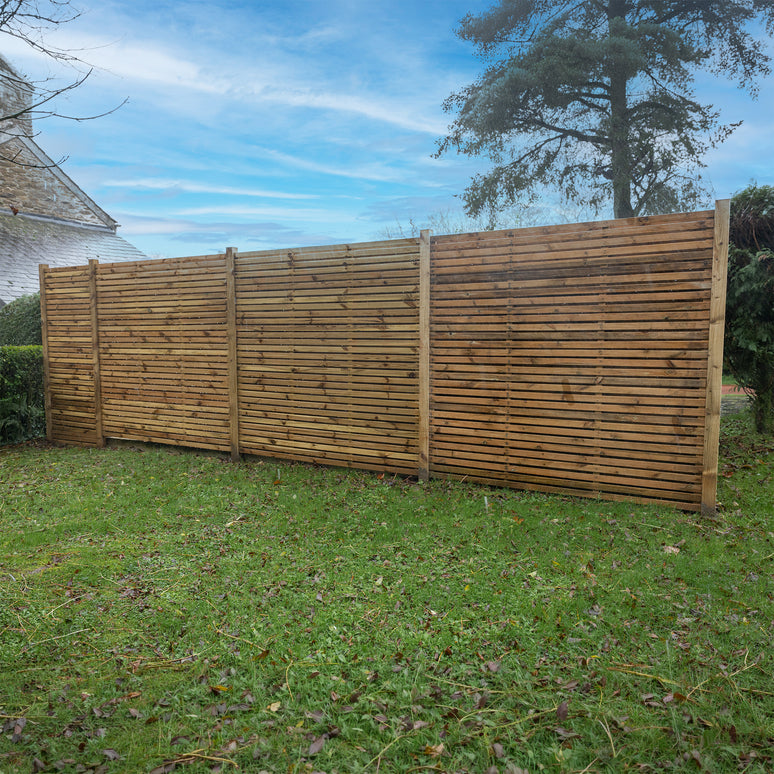
The above image shows the Cedar Slatted Fence panel that has narrower 6mm gaps. We supply this.
B. Is the fence a visual feature or just a boundary?
-
Feature fence → Natural timbers like Cedar or Larch
-
Background boundary → Treated PSE panels

Above shows the Treated PSE fence panels.
C. Are you willing to maintain colour?
-
Yes → Natural timbers are suitable
-
No → Expect greying over time (this is not a fault)
Being clear on these points prevents overspending or disappointment later.
2. Understanding slat spacing (this matters more than timber)
Gap size determines privacy, light flow, and visual weight.
Standard slatted panels (≈16mm gaps)
-
Allows significant light and airflow
-
Maintains open sightlines
-
Best for:
-
Modern gardens
-
Areas where privacy isn’t critical
-
Preventing “boxed-in” spaces
-
Trade-off: Limited privacy at close distances.
Reduced gap slatted panels (≈6mm gaps)
-
Harder to see through at eye level
-
Still allows light penetration
-
Best for:
-
Urban gardens
-
Overlooked boundaries
-
A balance of openness and privacy
-
Trade-off: Slightly heavier visual appearance.
Double-slatted panels (full privacy)
-
Slats are offset on both sides
-
No direct sightlines
-
Same modern aesthetic from either side
-
Best for:
-
Garden boundaries
-
Neighbours in close proximity
-
Noise and wind reduction
-
Trade-off: Higher cost and reduced light transmission.

Above shows the double sided timber fence panel.
3. Horizontal vs vertical slatted fencing (purely visual, not structural)
There is no performance difference when built correctly.
Horizontal slats
-
Strongly modern appearance
-
Visually widens narrow gardens
-
Most popular for contemporary designs
Vertical slats
-
More architectural and subtle
-
Emphasises height
-
Better suited to taller installations
Choose based on proportion, not trends.
4. Timber choice: what you gain and what you give up
British / Home-Grown Cedar Slatted Panels
Best for: premium appearance, low maintenance, modern colour
Why choose cedar
-
Naturally rot resistant
-
Stable timber with minimal movement
-
Pale red tones that age gracefully
What to know
-
Will silver naturally without UV oil
-
Higher upfront cost
-
Light weight compared to hardwoods
Choose cedar if
-
The fence is a design feature
-
You want long service life with minimal intervention
-
Budget allows for premium materials
British / Home-Grown Larch Slatted Panels
Best for: strength, colour depth, value-for-money premium
Why choose larch
-
Naturally durable and dense
-
Deep red colour when new
-
Excellent structural strength
What to know
-
Will fade faster without treatment
-
Slightly more movement than cedar
-
Requires oiling if colour retention matters
Choose larch if
-
You want a bold, modern look
-
Budget is mid-range
-
You’re happy to maintain colour periodically
Pressure-Treated Planed (PSE) Slatted Panels
Best for: budget, longevity, practicality
Why choose PSE
-
Fully pressure treated (not dip treated)
-
Resistant to rot and decay
-
Smooth, uniform finish
What to know
-
Lacks the natural colour character of cedar/larch
-
Designed to be stained or painted
-
Most cost-effective option
Choose PSE if
-
Budget is the main constraint
-
The fence is functional rather than decorative
-
You want predictable lifespan at lower cost
5. Budget logic (how to avoid paying for the wrong thing)
| Budget Level | Best Choice | Reason |
|---|---|---|
| Low | PSE Treated Slatted | Longevity at minimal cost |
| Mid | Larch Slatted | Natural durability + strong aesthetics |
| High | Cedar Slatted | Premium look + minimal maintenance |
Rule of thumb:
If you won’t oil it regularly, don’t pay extra for colour.
6. Installation considerations most guides ignore
Posts matter more than panels
-
Match timber species where possible for consistent movement
-
Ensure correct post sizing for panel weight
-
Proper spacing prevents long-term sagging
Fixings are not optional details
-
Stainless or coated fixings prevent staining
-
Incorrect fixings reduce panel lifespan
Fully assembled panels
-
Faster installation
-
Consistent spacing
-
Reduced risk of alignment errors
7. Maintenance: honest expectations
No timber fence is maintenance-free.
Without treatment
-
Cedar & larch will silver naturally
-
Structural integrity remains intact
With treatment (recommended)
-
UV oil every 6–12 months
-
Preserves colour
-
Reduces surface checking
This is aesthetic maintenance, not structural necessity.
8. Customisation & bespoke options
Slatted fencing is highly adaptable:
-
Custom panel sizes
-
Bespoke gap spacing
-
Vertical or horizontal layouts
-
Privacy-focused designs
Bespoke panels are ideal when:
-
Working around existing structures
-
Matching architectural features
-
Avoiding awkward infill sections
Final decision shortcut
If you want maximum impact → Cedar
If you want best balance of cost and style → Larch
If you want modern look on a budget → PSE Treated
If you want privacy above all else → Double-slatted panels
If you want light and openness → Standard gap panels