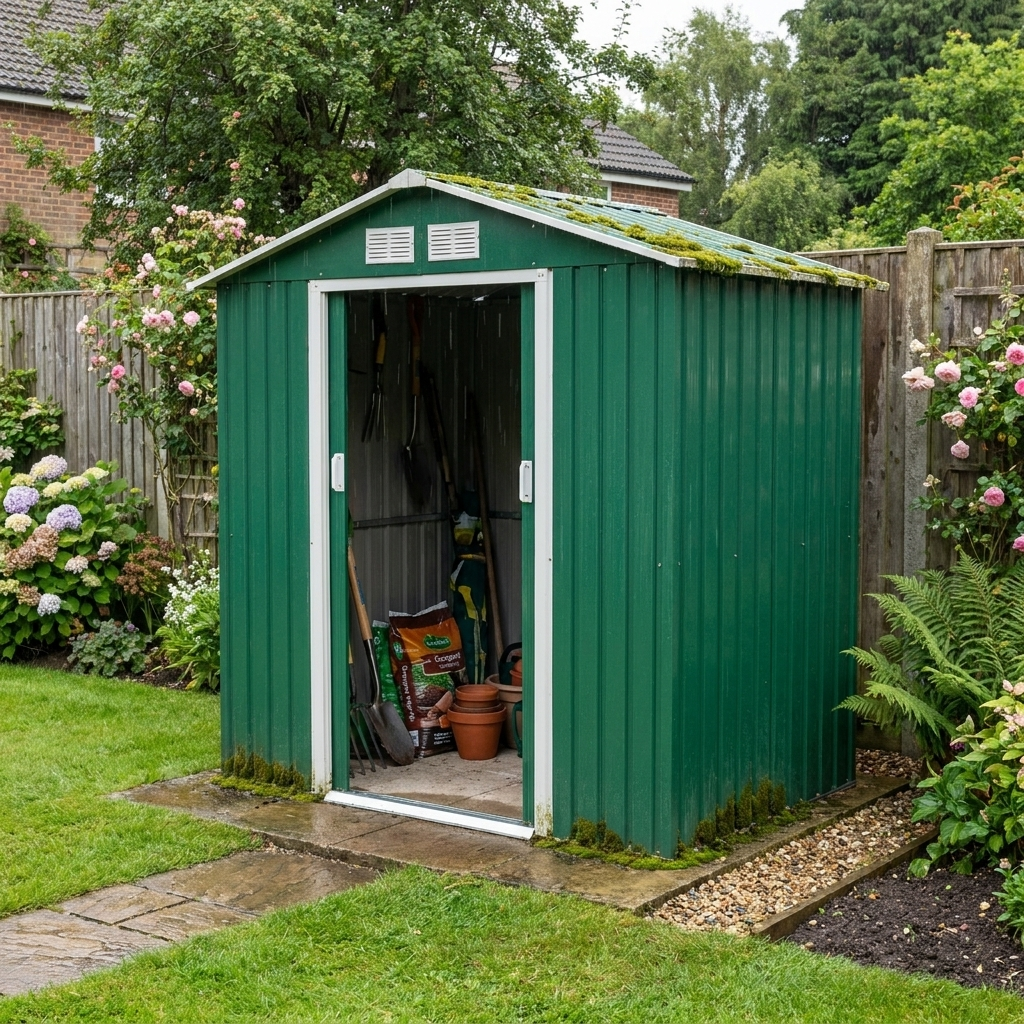
You stored a good selection of tools in the shed last autumn. Come spring, you open the door and are greeted by the unsightly sight of rust growing on the chisels, damp patches on the wooden handles, and the unmistakable smell of dampness and decay.
Everything looks to be in working order. No flood, no leak, and no major mishap. Just a case of condensation – quietly damaging your tools over the winter months.
It's one of the most common complaints of metal shed owners in the UK. It's also one of the most underestimated. A rusted hand saw, seized drill chuck, or mould-covered workbench aren't just inconvenient — they represent real money, and real frustration.
The good news is that a condensation problem in a metal shed can be prevented. It can be solved. But first, you need to understand what's going on and what you can do to prevent it.
Why Metal Sheds Are Particularly Vulnerable
All sheds experience some level of humidity. The reason metal sheds suffer more than their timber counterparts comes down to one fundamental property: thermal conductivity.
Steel conducts heat far more efficiently than wood. When the temperature drops overnight, the metal panels of the shed cool rapidly — much faster than the air inside. When warm, moisture-laden air meets a cold metal surface, the moisture condenses out of the air and forms water droplets on the roof and walls. This is the same process that fogs up a cold bathroom mirror when you shower, or beads water on a cold glass on a warm day.
Timber, by contrast, is a natural insulator. It buffers temperature change, actually absorbs some moisture into its structure, and releases it slowly — reducing the severity of condensation events. Metal does none of this. It swings from cold to warm and back again with the outside temperature, creating the ideal conditions for repeated condensation cycles throughout autumn, winter, and into spring.
In the UK's damp, variable climate — where overnight temperatures regularly drop sharply even after mild days — this cycle happens constantly. Each event leaves a fine film of moisture on every surface inside the shed. Over time, that adds up to serious damage.

What Condensation Actually Does to Your Shed Contents
Tools and Metal Equipment
Iron and steel rust when exposed to moisture and oxygen. Condensation provides both in abundance. Surface rust on hand tools looks cosmetic at first but quickly becomes structural — a rusted file loses its cutting ability, a corroded chisel head becomes dangerous to strike, and a seized socket set is effectively worthless.
Power tools are more sensitive still. Moisture inside a drill or circular saw can corrode internal components, degrade electrical contacts, and cause motor windings to fail. A tool that's been through a damp winter in a poorly ventilated shed may work fine the first time you pick it up — and fail unpredictably under load a few months later.
Timber and Wooden Handles
Wooden tool handles, workbenches, shelving, and storage units absorb moisture from the air when humidity is persistently high. The wood swells, warps, and over time develops mould and rot.
A handle that's been through several damp winters will feel spongy, may develop cracks as it dries out in summer, and can fail under pressure — which on a striking tool is a safety issue, not just an inconvenience.
Cardboard, Fabric, and Paper
Spare parts stored in their original boxes, instruction manuals, dustsheets, workwear left in the shed — all of these are rapidly affected by persistent damp.
Cardboard softens and disintegrates. Fabric develops mildew. Paper goes wavy and brittle. If you store anything that isn't metal or plastic in a metal shed, condensation will find it.
The Shed Itself
It's not just the contents at risk — condensation damages the shed structure too. Water pooling in the base channels of the wall panels accelerates corrosion from the inside. Fixings and screws rust, making future maintenance and panel replacement harder.
A shed that's allowed to corrode internally can develop structural weakness long before any rust appears on the exterior. For a full picture of how this affects long-term durability, our guide on the average life expectancy of a metal shed is worth reading before you draw conclusions about how long yours should last.
The Main Causes of Condensation in a Metal Shed
Understanding the cause is essential to choosing the right fix. Condensation in a metal shed is almost always driven by one or more of these factors:
Temperature differential: Cold metal panels meeting warm interior air. Most severe overnight in autumn and spring when day-night temperature swings are largest.
Poor ventilation: Without adequate airflow, moist air accumulates inside the shed rather than being exchanged with drier air from outside. Many metal sheds have minimal built-in ventilation — often just a single louvred vent or gap at the ridge.
Moisture sources inside the shed: Wet tools, damp clothing, plant pots, or a concrete floor that hasn't fully cured all contribute moisture to the air inside the shed.
Ground moisture: A shed sitting directly on soil, or on a base without a proper damp-proof membrane, will wick ground moisture upward continuously. This is a source of humidity that most people don't think about. Getting the base right is one of the most important steps — our guide on how to prepare the ground for a metal shed covers this properly.
Seasonal changes: The transition from winter to spring is when condensation tends to peak. The outside air warms and becomes more humid, but the metal panels are still cold from winter — creating ideal condensation conditions every morning.
How Bad Is Your Condensation Problem? A Quick Diagnostic
| Symptom | Likely Cause | Severity |
|---|---|---|
| Light surface rust on tools | Occasional condensation events | Moderate — address promptly |
| Persistent musty smell | Poor ventilation, moisture accumulation | Moderate — ventilation upgrade needed |
| Water droplets visible on roof/walls in morning | Severe overnight condensation | High — insulation and ventilation required |
| Rust at base of wall panels | Ground moisture or pooling water | High — base and drainage issue |
| Mould on wood, fabric or cardboard | Chronic high humidity | High — multiple interventions needed |
| Rust streaks on exterior from inside out | Internal corrosion at fixings | Severe — structural concern |
How to Fix Condensation in a Metal Shed: The Right Approach
There is no single silver bullet here. Condensation in a metal shed is almost always a combination of factors, and the most effective solution addresses several of them simultaneously. The good news is that the fixes aren't expensive or technically demanding — they just need to be done properly.
1. Insulate the Shed
This is the single most impactful change you can make. Insulation works by raising the temperature of the interior surfaces — specifically the metal panels — so they're closer to the temperature of the air inside. When the temperature differential between the air and the wall surfaces is reduced, condensation is dramatically reduced too.
The most practical insulation options for a metal shed are:
Foil-backed bubble wrap insulation (sold specifically for shed and garage use): lightweight, easy to cut and fix, and effective for the purpose. It reflects heat back into the shed and raises panel temperature. Fix it directly to the metal frame with appropriate adhesive or staples, leaving the foil face visible on the interior side.
Rigid foam insulation boards (PIR or EPS): more effective thermally than bubble wrap but bulkier and more involved to install. Best suited to larger sheds where the interior space can absorb the reduced dimensions.
Mineral wool or fibreglass batts: effective if you're building a timber frame inside the shed to create a lined interior, but overkill for most domestic metal shed applications.
Whatever you use, pay attention to the roof — warm air rises, and the roof is both the largest surface area and the highest condensation risk. A shed insulated only on the walls but not the roof will still suffer significant drip-down condensation from above. Our detailed guide on how to insulate a metal shed walks through the full process with specific product guidance.
2. Improve Ventilation
Insulation reduces condensation; ventilation manages the humidity that causes it. Both are needed — insulation alone in a poorly ventilated shed will reduce condensation events but won't eliminate them, because moisture still accumulates in the trapped air.
The goal is a gentle, consistent air exchange that replaces humid interior air with drier air from outside, without creating draughts that cool the shed interior too rapidly.
Add roof vents or a ridge vent if the shed doesn't already have them. Hot, moist air rises — a vent at the highest point of the shed gives it somewhere to escape.
Add low-level vents on opposite sides of the shed to create cross-ventilation. Air needs to enter somewhere as well as exit.
Leave the door open for an hour after use when practical — particularly in summer, when exterior air is relatively dry. This alone makes a meaningful difference to ambient humidity inside the shed.
Don't store wet tools or damp materials in the shed without allowing them to dry first. Every wet item you bring in adds moisture to the air.
3. Use a Dehumidifier or Desiccant
For sheds where ventilation is structurally limited — older designs with few vent options, or sheds in very sheltered positions — a small electric dehumidifier is a highly effective solution. Even a compact unit running occasionally will significantly reduce ambient humidity.
For sheds without a power supply, renewable desiccant dehumidifiers (the type with crystals that absorb moisture and can be reactivated in an oven) provide a passive alternative. They won't transform a severely damp shed, but as part of a broader approach they contribute meaningfully.
4. Sort the Base and Ground Moisture
If the shed sits on bare soil, compacted hardcore without a membrane, or an older concrete base without damp proofing, ground moisture will be a continuous source of humidity regardless of what you do above ground level.
A proper damp-proof membrane under the shed base — or laid on top of a concrete base and under any timber flooring — breaks this connection and removes a significant moisture source from the equation.
5. Anti-Condensation Coating
Some metal shed manufacturers and specialist suppliers offer anti-condensation coatings or sprays that can be applied to the interior metal surfaces. These work by creating a slightly textured surface that encourages water droplets to be absorbed rather than dripping — buying time for the moisture to evaporate rather than pooling on tools and surfaces below.
They're not a substitute for insulation and ventilation, but as an additional measure on a shed that's already been improved in other ways, they can be worthwhile — particularly on the underside of the roof where drip-down is the most damaging.
For a complete step-by-step breakdown of all these approaches together, our dedicated guide on how to prevent condensation in a metal shed covers the full methodology.
Prevention vs Cure: What to Do Right From the Start
If you're buying a new metal shed rather than dealing with an existing condensation problem, you have the opportunity to get ahead of the issue from day one.
Choose a shed with adequate ventilation built in. Check the specification before you buy — how many vents does it include, and are they positioned at both low and high levels? A single louvred vent isn't sufficient for most shed sizes.
Lay the base correctly. A well-prepared, drained base with a proper damp-proof membrane eliminates ground moisture before it starts. Don't cut corners here — it's far easier to do it right during installation than to address rising damp after the shed is in place.
Insulate before you fill it. Fitting insulation to an empty shed is straightforward. Doing it around an established workshop full of tools and shelving is considerably more work. If you're going to insulate — and for a metal shed used year-round, you should — do it before moving anything in.
Consider whether a metal shed is the right choice. Metal sheds have real advantages — they're generally more affordable, more secure against opportunistic break-ins, and lower maintenance externally. But if you're storing valuable tools, electronics, or anything sensitive to moisture, a timber shed's naturally better insulating properties may make it a more suitable choice. Our honest comparison of metal versus wooden shed costs and performance is a useful reference if you're still deciding.
Protecting Your Tools in the Meantime
While you're working on the shed itself, there are steps you can take to protect the contents from condensation damage in the short term.
Tool boxes with foam inserts buffer temperature change better than open shelving, slowing the condensation cycle on the tools stored inside them.
Silica gel sachets placed in tool drawers and boxes absorb ambient moisture from enclosed spaces. Cheap, effective, and easily reactivated by drying in an oven.
Camellia oil or light machine oil applied to unpainted metal tool surfaces creates a moisture barrier that significantly slows rust formation. A quick wipe-over before storing tools for winter takes five minutes and makes a real difference.
VCI (Vapour Corrosion Inhibitor) products — papers, bags, and emitters that release a corrosion-inhibiting compound into the air around stored metal — are widely used in industrial storage and increasingly available for domestic use. Particularly useful for precision tools and anything you don't use regularly.
FAQs: Metal Shed Condensation
Is condensation in a metal shed normal? Some degree of humidity fluctuation is normal in any outdoor structure. But visible water droplets on walls and ceilings, persistent dampness, and rust forming on tools are not things you should accept as inevitable. They indicate that the shed lacks adequate insulation, ventilation, or both — and all of these are fixable.
Will painting the inside of my metal shed help with condensation? Standard paint won't make a meaningful difference to condensation. Anti-condensation coatings — specifically formulated to manage moisture on metal surfaces — can help as part of a broader approach, but they won't solve the problem on their own. Insulation and ventilation are the primary interventions.
My shed has vents — why is it still getting condensation? Most standard metal sheds include minimal ventilation — often a single louvred vent that's insufficient for the shed's volume, or positioned in a way that doesn't encourage effective air exchange. Check whether your vents are on opposite sides of the shed (needed for cross-ventilation) and whether there's any provision for hot air to escape at ridge level. Adding supplementary vents is usually straightforward.
Does where I position my metal shed affect condensation? Yes, meaningfully. A shed in a shaded, north-facing position stays colder for longer and experiences more severe condensation than one that gets morning sun. Positioning a metal shed to catch morning sunlight helps warm the structure earlier in the day, reducing the overnight temperature differential. Avoid positioning directly against walls or fences where airflow is restricted.
Can condensation cause my metal shed to rust through? Yes — internal condensation is one of the primary causes of metal shed corrosion, particularly at the base channels and around fixings where water pools rather than evaporating. This kind of internal rust can progress significantly before it's visible from outside. Our guide on how to prevent a metal shed from rusting covers both prevention and treatment of rust at different stages.
Should I leave my metal shed door open to reduce condensation? On dry days — particularly during warmer months when exterior air is relatively dry — leaving the door open for a period after use helps exchange moist interior air for drier outside air. Avoid leaving it open overnight or during rain, when exterior humidity is high and the benefit reverses.
Conclusion
Condensation in a metal shed isn't dramatic. It doesn't announce itself the way a leaking roof or a break-in does. It just works quietly in the background — cycle after cycle, night after night — until the tools you spent years accumulating are rusted, the handles are rotten, and the shed itself is corroding from the inside.
The fix isn't complicated, but it does require addressing the problem properly rather than hoping it'll sort itself out. Insulate the panels — roof especially. Add meaningful ventilation at both low and high levels. Sort the base if ground moisture is a factor. Manage what you bring in and how wet it is. Do those things and a metal shed becomes a genuinely practical, long-lasting storage solution.
If you're in the market for a new shed and want to start on the right foot, browse the full metal garden shed range — or if you're weighing up whether timber might be a better fit for what you're storing, take a look at the wooden garden shed collection too. And for everything else you need to know about getting the most from your garden shed, the shed advice blog is a useful place to start.
Your tools are worth protecting. The shed should be working with you, not against you.