
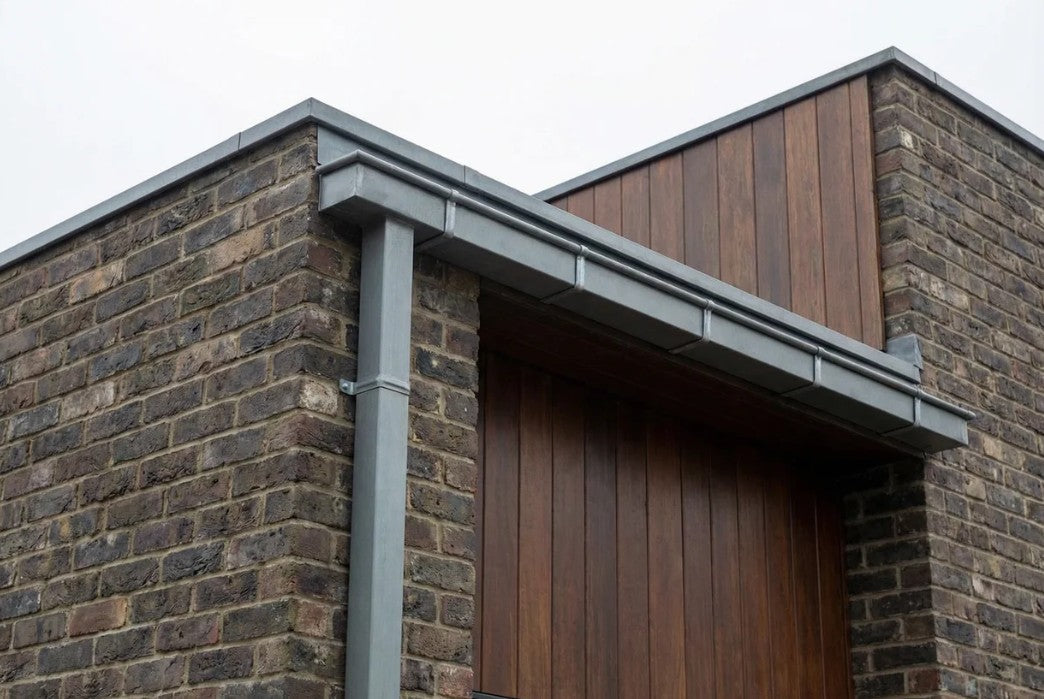
If you’ve already decided on zinc for your rainwater system, there’s another choice to make: box profile or half round?
Both can look fantastic. Both offer the distinctive appearance and long-term appeal people choose zinc for. But they don’t look the same, they aren’t installed in quite the same way, and one may make much more sense for your roof than the other.
Here’s what actually matters when choosing between them.
What’s The Main Difference?
The obvious difference is the shape.
Half round zinc guttering has the familiar curved profile found on traditional rainwater systems. It works just as comfortably on period properties as it does on modern extensions, particularly when the aim is for the guttering to sit neatly beneath the roofline rather than dominate it.
Zinc box guttering is much more angular. The straight front face and deeper rectangular profile give it a stronger architectural appearance, which is why you’ll often see it paired with modern extensions, zinc roofs, dark cladding and contemporary new builds.
Our Quartz Zinc box gutter measures approximately 120mm wide × 85mm deep and comes in 3m lengths.
Zinc Box vs Half Round At A Glance
| Half Round Zinc | Zinc Box Guttering | |
|---|---|---|
| Appearance | Softer, curved profile | Sharp, architectural profile |
| Best suited to | Traditional and contemporary homes | Contemporary homes, larger roofs and commercial projects |
| Options at Trade Warehouse | Natural Zinc and Quartz Zinc | VMZINC Quartz Zinc |
| Sizes | Natural Zinc: 115mm, 125mm and 150mm | Approx. 120mm × 85mm |
| Gutter length | 3m | 3m |
| Downpipe options | 80mm and 100mm depending on system | 80mm or 100mm |
| Installation | System dependent | Main joints require professional soldering |
| Overall look | Understated | More prominent |

Which Looks Better?
This really comes down to the building.
Half round zinc has a softer appearance. On brick houses, period renovations, cottages and more traditional architecture, that can be exactly what you want.
But don't assume half round means old-fashioned. A clean Natural Zinc or Quartz Zinc guttering system can look excellent on a modern extension too.
Box guttering makes more of a statement.
Its straight lines work particularly well where the rest of the building already has strong geometric detailing - large aluminium windows, standing-seam zinc, vertical cladding or a flat-roof extension, for example.
If you're trying to make the rainwater goods feel like part of the architecture rather than something added afterwards, box profile is often the more interesting option.
Does Box Guttering Carry More Water?
Potentially, yes, but this needs a little more explanation.
The larger rectangular section of a 120mm zinc box gutter gives it useful capacity, and specialist suppliers position these systems for larger houses, higher-pitched roofs and small commercial buildings where greater rainwater flow may need to be handled.
However, gutter shape alone doesn't determine whether a system is big enough.
You also need to consider:
- roof area and pitch
- the number and position of outlets
- local rainfall intensity
- downpipe diameter
- the number of downpipes serving the roof
So we wouldn't recommend choosing box guttering simply because somebody says it “holds more water”.
For larger projects, send us the roof dimensions or drawings and we can help you work through the system.

What About Half Round Gutter Sizes?
This is actually one of the biggest advantages of our Natural Zinc range.
We offer 115mm, 125mm and 150mm half round gutters, allowing the system to be scaled more closely to different roof sizes.
The 115mm profile keeps things neat on smaller roofs and extensions, while 125mm provides a useful middle ground for many residential projects. For larger roof areas, 150mm gives you considerably more gutter to work with.
So a large roof doesn't automatically mean you need box guttering.
A correctly sized half round system may still be the better option, particularly if you prefer its appearance.
Natural Zinc Or Quartz Zinc?
This is another difference worth considering.
Our Natural Zinc half round system is manufactured by Zambelli. When first installed, it has the brighter metallic appearance of new zinc. Over time, the surface naturally weathers and develops the softer grey patina associated with zinc rainwater goods.
We also supply pre-weathered Quartz Zinc, which already has that darker grey appearance from day one.
Our 120mm zinc box guttering is made from VMZINC Quartz Zinc, making it particularly well suited to projects where a consistent, pre-weathered architectural finish is wanted immediately.

Above shows the Zambelli Natural Zinc System in Use.
Which One Is Easier To Install?
This is where there is a fairly significant difference.
Half Round Zinc
Our Zambelli Natural Zinc system has been designed to make installation relatively straightforward.
Gutter lengths connect using snap-fit unions with rubber seals, while the stop ends push into position. That means the gutter runs can be assembled without soldering.
Our Quartz Zinc half round system uses its own jointing method with Körapop Concrete Grey adhesive and sealant.
Zinc Box Guttering
The VMZINC box system requires more specialist installation.
The main gutter lengths, angles and outlets are soldered together, and longer runs also need appropriate provision for thermal expansion and contraction. Specialist guidance for this system recommends movement provision rather than simply soldering an unrestricted continuous run.
For that reason, we'd generally steer competent DIY installers towards one of the simpler half round systems.
For an architectural project where an experienced zinc installer is already involved, the box system makes much more sense.
80mm Or 100mm Downpipes?
Whichever profile you choose, don't forget about what happens after the water reaches the outlet.
Our zinc downpipes include 80mm and 100mm systems, and our VMZINC box gutter has outlet options for both.
You shouldn't automatically choose 100mm because it's bigger. The right pipe depends on how much roof water needs to be handled and how many outlets and downpipes are being used.
It's much better to plan the gutter, outlet and downpipe together.
And where several drainage routes need bringing together, a zinc hopper head can form part of the system too.
Is Zinc Box Guttering The Same As A Concealed Box Gutter?
No — and this causes quite a bit of confusion.
The system we're talking about here is an external fascia-mounted zinc box gutter. It has a rectangular profile, but it still sits visibly along the edge of the roof like conventional guttering.
A concealed or internal box gutter is built into the roof construction itself, often behind a parapet or between roof slopes.
Those are completely different drainage details.
If an architect's drawing specifies a concealed zinc-lined gutter, don't assume an external 120mm box gutter is an interchangeable alternative.
So, Which Should You Choose?
For most projects, I'd start with the appearance you want and then check that the system has enough capacity for the roof.
Choose half round zinc guttering if you want a softer profile, more size choice or a simpler installation. It's particularly versatile because it works on both traditional houses and clean contemporary extensions.
Choose zinc box guttering if you're after stronger architectural lines, want the pre-weathered VMZINC Quartz finish and have a project where the larger profile suits the roof and the building.
The installation is more specialist, but on the right property the finished result is hard to beat.
If you're still not sure, send the Trade Warehouse team your roof dimensions or drawings. We can help you compare the profiles and work out the gutters, outlets, zinc downpipes and fittings you'll need before you order.
