
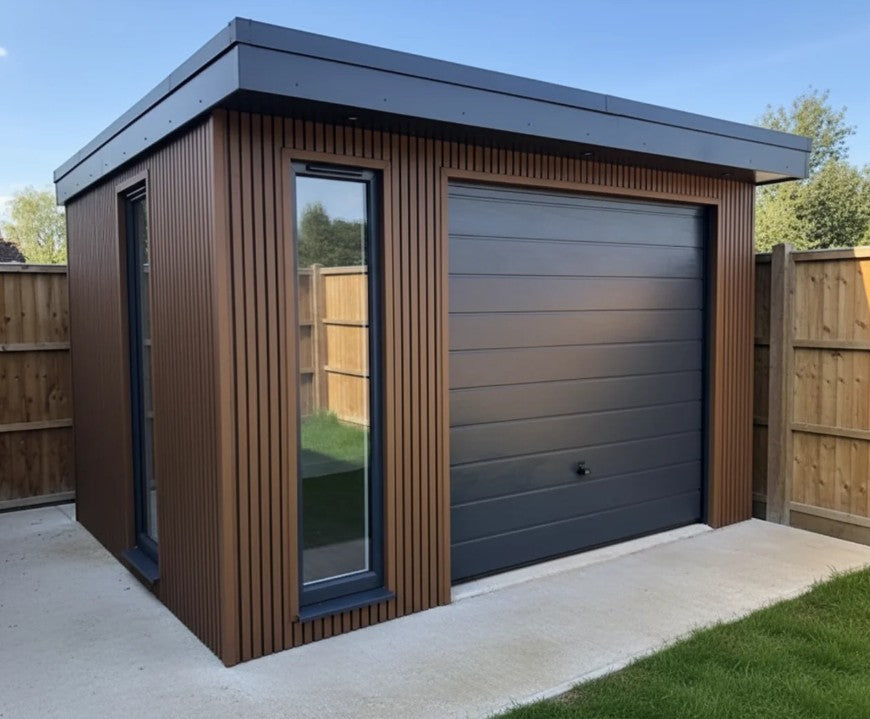
It’s one of the most common questions we're asked by people looking to undertake a project outside their house: can composite slatted cladding be put onto a brick wall, or does it need a timber framework behind it?
The simple answer is yes, and it’s something that’s commonly done all over the UK - from old Victorian homes to modern brick-built extensions. In fact, brick is a great material for composite slatted wall cladding, and it’s something you can do with the right help guide. The boards don’t attach directly to the brick - it's the subframe that makes all the difference. With the right subframe in place, the composite cladding will go onto the brick wall nicely and will last you for many years.
The problem with many projects is that people don’t put in the time and effort to do things right, and they think that composite cladding is so strong and durable that it will work with anything behind it. It will not, and this guide will show you everything you need to know.
Quick Reference: Installing Composite Cladding on Brick
| Stage | What's Required |
|---|---|
| Wall assessment | Check for damp, crumbling mortar, and plumb |
| Damp proofing | DPC tape or breather membrane behind battens |
| Subframe | Treated timber or aluminium battens fixed to masonry |
| Fixings | Masonry anchors or frame fixings into brick, not mortar joints |
| Ventilation gap | Minimum 25mm air gap behind the cladding |
| Board installation | Hidden clip or face-fix depending on board profile |
Why Brick Needs a Subframe — Not a Direct Fix
Composite cladding boards are not designed to go straight onto masonry.
Even if you could fix them directly, you'd be creating a serious moisture problem. Brick is a naturally porous material - it absorbs rainfall, breathes, and releases moisture throughout the year. If composite boards were butted directly against it, there'd be no airflow, moisture would be trapped, and over time you'd get damp penetration into the wall structure.
The subframe; a grid of timber or aluminium battens fixed to the brick face; actually solves this in one go. It gives you a flat, level surface to fix the cladding boards to, creates the essential ventilation cavity between the boards and the brickwork, and allows any water that gets behind the cladding to drain freely downward and escape at the base.
Think of it the same way a rainscreen cladding system works on a commercial building — that cavity behind the boards is doing important work, not just taking up space.

Step 1: Assess the Brickwork Before You Start
Before any fixings go in, spend time properly looking at the wall. This is the stage that separates installations that stay sound for 20 years from ones that cause problems within five. You can always email us with images for help: info@tradewarehouse.co.uk
Check for damp. If the brick face shows white efflorescence (salt deposits), dark staining, or feels wet to the touch after dry weather, there may be an underlying damp issue — rising damp, a failed DPC, or water tracking in from above. Cladding over a damp wall traps the problem and makes it worse. Identify and resolve the cause first.
Check the mortar joints. Crumbling or recessed mortar joints are a common issue on older brickwork. They need raking out and repointing before you fix a subframe — a masonry anchor into soft mortar is not a reliable fixing, and the movement will eventually loosen your battens.
Check for plumb. Hold a long spirit level against the wall and see how far out it is. Some variation is normal and can be corrected by packing your battens during installation. If the wall is more than 20–25mm out of plumb, you'll need a systematic shimming approach or an adjustable bracket system to bring the cladding face into line.
Check for obstructions. Pipes, sockets, meter boxes, outside taps — note where everything is. Plan your subframe layout around these rather than discovering conflicts mid-install.
Step 2: Choose Your Subframe Material
You have two main options: treated timber battens or aluminium channel battens. Both work well; the choice depends on budget, board weight, and personal preference.
Treated timber (most common): Tanalised softwood battens — typically 50×38mm or 50×50mm — are the standard choice for most domestic composite cladding installations. They're cost-effective, easy to work with, and readily available. Make sure they're pressure-treated to at least Use Class 3 (above-ground, exposed to weather). Untreated timber in a damp cavity will deteriorate far faster than the composite boards above it.
Aluminium battens: More expensive than timber but more dimensionally stable and completely rot-proof. Worth considering on large elevations, on walls with significant moisture exposure, or where the installation needs to last with truly zero maintenance. Some composite cladding manufacturers specify aluminium subframes for their warranty to apply — check your product documentation.
For a horizontal board installation, battens run vertically at 400–600mm centres. For vertical boards, you'll need a counter-batten arrangement — horizontal primary battens fixed to the wall, with vertical secondary battens fixed over them to maintain the drainage cavity.
Step 3: Fix the Subframe to Brick
This is where many DIY installations fall down. Fixing into brick requires the right anchors in the right places — and those places are the bricks themselves, not the mortar joints.
Why not the mortar? Mortar joints are the weakest point in the wall face. They're also more prone to water ingress and deterioration over time. Fixings in mortar joints work loose far more readily than those anchored into solid brick.
Recommended fixings:
- Frame fixings (nylon or stainless sleeved anchors) in 6mm or 8mm diameter are suitable for most timber batten installations
- Hammer-in or screw-in masonry anchors work well for aluminium extrusions
- For hollow or lightweight blocks sometimes found in newer construction, use specialist cavity fixings rated for the load
Pre-drill the brick with a hammer drill and correctly sized masonry bit. Fix at approximately 600mm vertical centres per batten, and always use at least two fixings per batten per storey to distribute the load.
Dealing with an uneven wall: Use timber packers or plastic shims behind the battens to bring everything into the same vertical plane before tightening fixings. Check each batten with a spirit level and a string line across the full installation area. Taking time here means every board goes on straight — rush it and you'll be fighting the boards for the rest of the job.
Step 4: Moisture Management — Don't Skip This
Brick walls breathe. That's generally a good thing, but it means moisture moves through them. Behind your cladding subframe, you need to manage this properly.
DPC tape behind battens: At minimum, apply a strip of damp-proof course tape to the brick face wherever a timber batten will be fixed. This stops direct moisture transfer from the damp brick face into the back of the timber.
Breather membrane: On exposed elevations — particularly those facing south-west and catching the prevailing UK weather — a breather membrane like the Cromar one fixed over the full brick face before the battens go on offers much better protection. It allows water vapour from the wall to escape outward while preventing liquid water from tracking back in. If you're unsure whether your project needs one, our guide on whether you need a membrane under composite cladding covers this in detail.
Ventilation at top and bottom: Ensure the base of the cladding has a clear gap above any hard surface — 15mm minimum — and that the top of the installation isn't completely sealed. Air needs to move through the cavity to carry moisture away. Installing a perforated or mesh trim at the base and top keeps insects out while maintaining airflow.

Step 5: Install the Cladding Boards
With a solid, level subframe in place, the board installation process on brick is identical to any other substrate.
The subframe has done the hard work of creating a consistent, flat surface to work from.
Starter strip first: Fix your starter strip or bottom rail level across the base of the installation. This sets the line for every board above it, so check it carefully with a spirit level across its full span before committing.
Hidden clip system: Most quality composite slatted cladding uses a hidden clip fixing where clips locate in the board groove and screw into the batten face. Work from the bottom up, inserting clips at each batten position and checking level every few courses.
Allow for expansion: Composite expands and contracts with temperature. Always maintain the manufacturer's specified end gaps — typically 5mm minimum — between the end of each board and any fixed structure. On south-facing brick walls that absorb and radiate heat, err toward the larger end of the recommended gap range. Boards that are cut tight will buckle in summer.
Cutting around brick reveals and obstacles: When cladding returns into a window or door reveal on a brick wall, you'll often be cutting boards to fit around the brick surround. Use a fine-tooth blade suitable for composite, cut face-down with a circular saw, and always cap or seal exposed cut ends. On external corners where the cladding wraps around a brick pier or corner, use a purpose-made corner extrusion rather than mitring the boards — composite doesn't hold a tight mitre over time the way timber does. The Triton composite cladding angle trim is a clean, colour-matched solution for exactly this situation, giving a professional finish to external corners and return edges.
Common Problems — and How to Avoid Them
| Problem | Cause | Solution |
|---|---|---|
| Battens pulling away from wall | Fixings into mortar joints | Always fix into brick; use correct anchor size |
| Damp behind cladding | No DPC or membrane; insufficient ventilation gap | Apply DPC tape to battens; maintain 25mm+ cavity |
| Boards bowing or buckling | No expansion gaps at board ends | Allow 5mm+ at each end; increase gap on sunny aspects |
| Cladding face visibly uneven | Subframe not packed level | Use string line to align all battens before fixing |
| Water ponding behind boards | Base of cladding too low or sealed | Maintain 15mm clearance; leave base ventilated |
| Rust staining on board face | Incorrect fixings used | Use stainless or manufacturer-specified clips only |
Does Building Regulations Approval Apply?
For most domestic composite cladding projects on brick walls — an external feature wall on a garden room, cladding a flat-roofed extension, or updating a boundary wall — building regulations approval isn't typically required.
However, if you're changing the external appearance of the principal elevation of a house, or if the project alters the thermal performance of the building envelope, it's worth checking with your local authority before starting.
Listed buildings and properties in conservation areas have additional restrictions — composite cladding may not be permitted at all in some cases, or may require consent. Always check first.
FAQs: Composite Cladding on Brick
Do composite cladding boards need to be fixed directly into the brick, or can they go into the mortar? They should never be fixed directly into mortar joints — and the boards themselves don't fix to the brick at all. The subframe (timber or aluminium battens) fixes into the brick, and the cladding boards then clip or screw into the subframe. Fixings for the subframe must go into the solid brick, not the mortar, which is the weakest point of any masonry wall.
Do I need a breather membrane behind composite cladding on a brick wall? It depends on the wall's exposure and condition. At minimum, DPC tape should be applied behind each batten. On exposed elevations — particularly those facing the prevailing weather — a full breather membrane over the brick face is strongly recommended. See our full guide on membranes under composite cladding for a detailed breakdown.
Can I install composite cladding on an old or uneven brick wall? Yes, provided the underlying brickwork is structurally sound. Crumbling or loose mortar should be raked out and repointed first. Unevenness in the wall face can be corrected by shimming or packing the battens — this is one of the advantages of using a subframe system. Significant plumb issues of more than 25mm may require adjustable bracket fixings rather than simple battens.
Will the cladding damage the brickwork underneath? No - if done correctly, the cladding system is independent to the brickwork.
The fixings penetrate the brick but don't cause structural damage, and the system can be removed and refitted if needed. If anything, cladding over brick offers additional weather protection to the underlying masonry.
How long will composite slatted cladding last on a brick wall? Most quality composite cladding products carry warranties of 15–25 years, and many will outlast that with proper installation. The longevity of the installation as a whole also depends on the subframe — a well-fixed, treated timber subframe should last 20+ years. Aluminium subframes will last indefinitely. Keeping the ventilation cavity clear and doing a basic clean annually will ensure the boards stay looking good throughout. Our composite cladding maintenance guide covers everything you need to know.
What's the best composite cladding for a brick wall exterior? A capped or co-extruded composite is always worth the extra investment for exterior use. The outer polymer shell provides significantly better resistance to UV fade, moisture absorption, and surface scratching than uncapped boards. For a brick wall that's going to be exposed to the elements, this isn't the place to cut costs on board quality.
Our Conclusion...
Fixing composite slatted cladding to a brick wall is completely achievable — and the end result can be genuinely transformative, turning a dated or plain brick elevation into something that looks considered and contemporary.
The fundamentals are straightforward: assess the brickwork before you start, build a solid and level subframe fixed into the brick itself, manage moisture with DPC tape or a breather membrane, maintain the ventilation cavity, and let the boards expand. Get those five things right and the rest of the installation follows naturally.
Where it goes wrong is almost always at the preparation stage — fixings into mortar joints that gradually work loose, battens fixed to a damp wall with no protection, or a subframe that wasn't properly levelled before the first board went on. Take the time to do it properly and you'll have a cladding installation that looks sharp and performs well for many years to come.
Ready to choose your boards? Browse our full range of composite slatted cladding to find the right colour, profile, and finish for your project. We also have a wide selection of composite guides to help you with your project.
